Choosing the wrong PVC water hose for a pump application doesn't just cause a product return — it causes a lost customer. PVC layflat hose and PVC spiral suction hose look similar on a price list, but they behave in completely opposite ways under pressure. If you're sourcing either product for resale, understanding that difference isn't optional.
PVC layflat hose and PVC spiral suction hose serve fundamentally different functions. Layflat hose is a discharge hose — it works under positive internal pressure and collapses when used on the suction side of a pump. Spiral suction hose is built to resist negative pressure and hold its shape under vacuum. Choosing between them comes down to one question: is the hose receiving water, or pulling it?

That single question — discharge or suction? — is the decision gate this article is built around. The sections below will walk through each product's construction, where each one belongs, and what distributors should think about when stocking both.
What Is PVC Layflat Hose?
Most buyers recognize layflat hose immediately — it's the flat, ribbon-like hose that expands when water flows through it. But knowing what it looks like isn't the same as knowing why it's built that way.
PVC layflat hose is a discharge hose made from a PVC inner tube reinforced with a woven polyester or nylon fabric layer[^1]. It lies flat when empty, inflates under positive internal pressure, and collapses back down when drained — making it compact for storage and transport.

The fabric reinforcement layer is what gives layflat hose its burst resistance under pressure. On our production line, the braided or woven textile is bonded between PVC layers — this construction resists outward expansion (burst) but provides almost no structural rigidity when the hose is empty or under suction.
Why the Structure Matters for Buyers
This is the part that trips distributors up. Because layflat hose looks like a flexible, versatile product, customers assume it can handle any direction of water flow. It cannot.
- Under positive pressure (water being pushed through): the hose inflates, holds its shape, and performs as designed.
- Under negative pressure (suction, vacuum): the hose walls are pulled inward. The fabric layer cannot resist this. The hose collapses and blocks flow entirely.[^2]
That collapse isn't a quality defect. It's a physics consequence of the design. When distributors receive complaints about layflat hose "blocking up" on a pump intake, the root cause is almost always misapplication — not a manufacturing problem.
Key properties of PVC layflat hose at a glance:
| Property | Detail |
|---|---|
| Structure | PVC + woven polyester/nylon fabric |
| Working mode | Positive pressure (discharge only) |
| Storage | Folds flat, rolls compactly |
| Typical applications | Agricultural irrigation discharge, dewatering, water transfer |
| Pressure direction | Outward (resists burst, not collapse) |
What Is PVC Spiral Suction Hose?
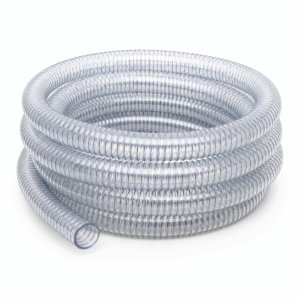
PVC spiral suction hose doesn't fold flat. It maintains a round cross-section even when empty. That's not a coincidence — it's the entire point of the design.
PVC spiral suction hose is a rigid-profile hose reinforced with a hard PVC or steel wire spiral rib running along its exterior[^3]. This spiral structure resists collapse under negative pressure (vacuum), allowing the hose to hold its shape on the suction side of a pump without deforming.

The spiral rib is the defining feature — and the reason suction hose costs more than layflat hose of the same diameter and length. That rib requires additional material, a different production process, and more precise construction to achieve consistent wall thickness around the spiral profile.
Understanding the Spiral Construction
From a production standpoint, the spiral rib is formed during extrusion by embedding a rigid helical element into or onto the hose wall. Depending on the product specification, this can be:
- Hard PVC spiral: lighter, more flexible, suitable for low-to-medium vacuum applications
- Steel wire spiral: heavier, more crush-resistant, used where the hose may be walked on or subjected to external mechanical pressure
Both variants share the same functional purpose: maintaining the hose's circular cross-section when the pressure inside drops below atmospheric.
Key properties of PVC spiral suction hose at a glance:
| Property | Detail |
|---|---|
| Structure | PVC body + hard PVC or steel wire spiral rib |
| Working mode | Negative pressure (suction) and positive pressure |
| Storage | Rolled (cannot fold flat) |
| Typical applications | Pump intake, water suction, irrigation system feeds |
| Pressure direction | Resists inward collapse |
One practical note for distributors: suction hose can also handle discharge applications. It's overbuilt for pure discharge work, but it won't fail. Layflat hose cannot safely be used in suction applications at all. The functional asymmetry only runs one direction.
Main Differences Between Layflat Hose and Suction Hose
The table below summarizes the core comparison — but read past it, because the table alone won't tell you which one a downstream customer actually needs.
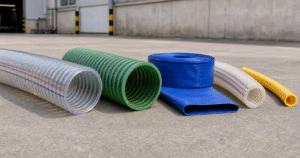
| Comparison | Layflat Hose | Spiral Suction Hose |
|---|---|---|
| Primary usage | Water discharge | Water suction |
| Reinforcement structure | Woven fabric layer | Spiral rib (PVC or steel wire) |
| Storage method | Folds flat | Rolled, round cross-section |
| Behavior under vacuum | Collapses | Holds shape |
| Relative cost | Lower | Higher |
| Weight | Lighter | Heavier |
| Flexibility | High | Moderate |
The cost difference comes directly from the structural difference. A spiral suction hose uses more material and a more complex production process. When distributors see suction hose priced 30–50% higher than layflat of the same diameter[^4], that gap is real — it reflects manufacturing cost, not margin inflation. Buyers who try to substitute layflat for suction hose to save cost will create downstream failures. That's not a price negotiation outcome — it's a warranty and reputation problem.
Which Hose Is Suitable for Irrigation?
Irrigation is where PVC layflat hose earns its reputation. Most irrigation discharge applications are a natural match for layflat hose — but the word "most" deserves attention.
For gravity-fed or pump-discharge irrigation systems, PVC layflat hose is the right choice. It handles the outward pressure of water being pushed through it, stores compactly for seasonal use, and offers cost-effective coverage over long field runs. It is not suitable for any irrigation line that sits on the suction side of a pump.

Thinking Through the Irrigation Use Case
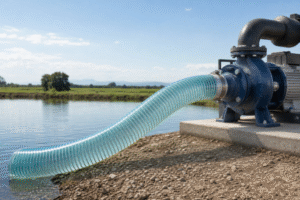
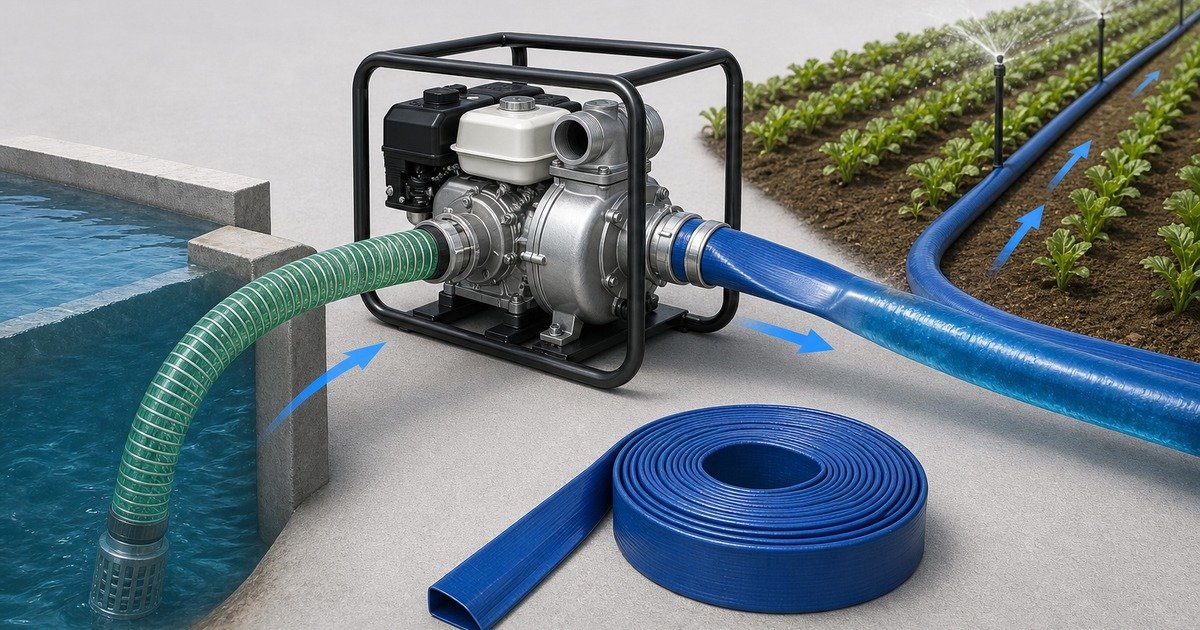
In a typical agricultural irrigation setup, a pump draws water from a source (river, tank, borehole) and pushes it through a distribution hose across a field.[^5] The distribution hose — the one running water to the crops — operates under positive pressure. That's where layflat hose belongs.
But the intake hose — the one connecting the water source to the pump inlet — is under suction. If someone uses layflat hose there, the pump creates a vacuum that immediately collapses the hose wall. Water flow stops. The pump runs dry.[^6] Distributors who work with small-scale farmers or irrigation contractors will recognize this scenario — it's one of the most common misapplication complaints in the field.
Irrigation decision rules:
- Pump outlet → field distribution line: use layflat hose
- Water source → pump inlet: use spiral suction hose
- Gravity-fed tank → field (no pump): layflat hose works fine
- Sprinkler or drip system feeder at pressure: layflat hose, check pressure rating
The practical implication for distributors: customers buying for irrigation should ideally buy both products — one layflat roll for discharge and one suction hose for the pump intake. Stocking them as a complementary pair, not as competing SKUs, is the smarter merchandising approach.
Which Hose Is Suitable for Pump Applications?
Pump applications are where most sourcing mistakes happen. The word "pump" alone doesn't tell you which hose to use — the critical question is where on the pump the hose connects.
For pump suction-side connections (intake), always use PVC spiral suction hose. For pump discharge-side connections (outlet), PVC layflat hose is suitable and cost-effective. The failure risk is specific to suction: layflat hose cannot withstand the negative pressure created at a pump inlet and will collapse.

Breaking Down the Pump Application Decision
A pump has two sides: the suction side (where water enters the pump) and the discharge side (where pressurized water exits). These two sides create completely different conditions for any connected hose.
Suction side conditions:
- Pressure drops below atmospheric
- Hose wall is pulled inward
- Any hose without structural rigidity will collapse
- Only spiral suction hose is appropriate here
Discharge side conditions:
- Pressure rises above atmospheric
- Hose wall is pushed outward
- Both layflat and suction hose can handle this
- Layflat hose is the cost-effective choice here
Distributors commonly encounter customers who describe needing a "pump hose" without specifying which side. Building a simple intake/outlet checklist into your sales process — or providing it to your downstream resellers — prevents the most common misapplication scenario.
One additional note: portable pump kits often include both a suction hose and a discharge hose[^7]. If you're sourcing complete pump accessory packages, matching suction hose on the inlet and layflat on the outlet is standard configuration. Sourcing both from the same factory ensures consistent fittings, compatible diameters, and matched quality specs — which matters when these hoses are sold as a set.
Buying Recommendations for Distributors
If you're importing PVC water hose for resale, the product selection question is only half of the decision. Inventory mix and sourcing structure are the other half.
Start with your market's dominant application. Irrigation-heavy markets (agricultural regions, seasonal farming markets) will move more layflat hose by volume[^8]. Pump equipment markets, construction dewatering, and fluid transfer applications need both products in near-equal proportion[^9]. Knowing your downstream customer's primary use case determines your opening stock ratio.
Stock both products, and know how they pair. Distributors who only stock layflat hose will lose pump intake orders. Distributors who only stock suction hose are paying more than they need to for every discharge application. The two products cover each other's blind spots — and customers who buy one often need the other.
Understand the price structure before competing on price. Spiral suction hose costs more for structural reasons. If a supplier quotes you suction hose at the same price as layflat, ask how the spiral reinforcement is constructed. Spec differences at the factory level often explain price anomalies that look like competitive deals but actually reflect downgraded product.
Consider sourcing both from a single factory. When layflat hose and spiral suction hose come from the same production source, you get compatible fitting standards, consistent wall thickness across diameters, and a single point of contact for quality issues. For distributors selling paired pump kits or irrigation bundles, this consistency reduces the chance of mismatched specs between the two hose types — a detail that matters when your customer's pump connection doesn't fit.
OEM and custom options are worth discussing with your supplier. Custom lengths, branded printing, color specifications, and fitting pre-assembly are common requests in resale markets. A factory that handles both hose types can coordinate these customizations across your full product range, rather than managing them through separate suppliers.
Frequently Asked Questions
Can I use PVC layflat hose on the suction side of a pump?
No. PVC layflat hose is designed for positive-pressure discharge only. Under suction (negative pressure), the hose wall collapses inward and blocks flow. Always use PVC spiral suction hose for pump intake connections. Using layflat on the suction side is one of the most common misapplication errors in pump and irrigation setups.
Is spiral suction hose more expensive than layflat hose?
Yes, typically. The spiral reinforcement rib — whether hard PVC or steel wire — requires more material and a more complex production process than the woven fabric layer in layflat hose. A 30–50% price difference for the same diameter and length is common and reflects real manufacturing cost differences.
Can spiral suction hose be used for discharge as well?
Yes. Spiral suction hose can handle both suction and discharge applications. It is overbuilt for pure discharge work, but it will not fail. The reverse is not true: layflat hose cannot be safely used for suction. If you need a single hose type for both functions, suction hose is technically capable — but the cost trade-off is worth considering.
What diameters are typically available for both hose types?
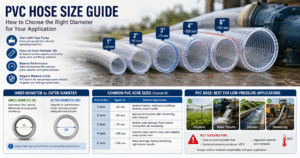
Both PVC layflat hose and PVC spiral suction hose are commonly available from 1 inch to 6 inches (25mm to 150mm)[^10], with some manufacturers offering larger diameter options for industrial applications. Always confirm inner diameter (ID) and confirm it matches your fittings and pump connection specs before ordering.
Should I stock both hose types as a distributor?
In most markets, yes. Layflat and spiral suction hose serve complementary roles in irrigation and pump systems. Customers who buy a pump setup typically need both. Stocking them together — and understanding which goes where — positions you as a knowledgeable supplier, not just a product catalog.
Conclusion
The choice between PVC layflat hose and PVC spiral suction hose isn't really a product preference — it's a functional decision based on where in a system the hose operates. Layflat hose handles discharge under positive pressure. Spiral suction hose resists collapse under vacuum. Mixing them up in a pump application doesn't result in reduced performance — it results in failure.
For distributors, the real value in understanding this difference is downstream confidence: fewer returns, clearer product recommendations, and customers who come back because the right product worked. Stock both, know how they pair, and source them from a factory that manufactures both under consistent quality standards.
If you're evaluating suppliers for PVC layflat hose, PVC spiral suction hose, or a combined product range for irrigation and pump markets, we manufacture both from a single facility with OEM and private label options available. Contact us to discuss your market requirements and volume needs.
[^1]: "Layflat", https://goodyearrubberproducts.us/wp-content/uploads/sites/2/119-Kuriyama-Layflat-Hose-Catalog-2022.pdf. International hose standards, including those published by ISO and relevant national bodies, define reinforced PVC layflat hose as comprising a thermoplastic inner tube bonded to a woven synthetic fibre reinforcement layer, providing burst resistance under positive internal pressure. Evidence role: definition; source type: institution. Supports: That layflat discharge hoses are typically constructed from a PVC matrix reinforced with woven synthetic textile, such as polyester or nylon. Scope note: Specific standard citations would require direct access to ISO 6945 or equivalent national standards; the article's construction description aligns with general industry practice but is not independently verified here. [^2]: "(PDF) The flow dynamics of the garden-hose instability", https://www.academia.edu/120379147/The_flow_dynamics_of_the_garden_hose_instability. Studies on flexible tube collapse under external or sub-atmospheric pressure demonstrate that thin-walled conduits lacking circumferential rigidity buckle inward when internal pressure drops below a critical threshold, consistent with the behavior described for fabric-reinforced layflat hose under suction conditions. Evidence role: mechanism; source type: research. Supports: That flexible-walled conduits without structural rigidity are subject to collapse under sub-atmospheric (negative) internal pressure due to net inward force on the wall. Scope note: Most published collapse analyses focus on biomedical or subsea tubing; direct experimental data on agricultural layflat hose may require extrapolation from general thin-shell buckling theory. [^3]: "DAVCO 1/2" ID 25 ft Reinforced Vinyl Tubing Clear PVC Suction Vacuum ...", https://www.amazon.com/DAVCO-Reinforced-Pressure-Non-Toxic-Collection/dp/B09W4KSB5X. Standards governing suction and vacuum hoses, such as those within the ISO 6945 series or EN 12115, specify that hoses intended for sub-atmospheric service must incorporate a structural reinforcing helix sufficient to prevent wall collapse at rated vacuum levels. Evidence role: definition; source type: institution. Supports: That vacuum-rated flexible hoses are characterised by a rigid helical reinforcing element — either plastic or metal — embedded in or applied to the hose wall to maintain circular cross-section under sub-atmospheric pressure. Scope note: The article does not specify a pressure or vacuum rating; the appropriateness of PVC versus steel wire spiral depends on application-specific vacuum depth, which varies and is not addressed in available general references. [^4]: "Irrigation & Water Use | Economic Research Service - ERS.USDA.gov", https://www.ers.usda.gov/topics/farm-practices-management/irrigation-water-use. Industry procurement references and agricultural supply catalogues indicate that structurally reinforced suction hoses carry a significant price premium over discharge layflat hose of the same nominal diameter, attributable to additional raw material and manufacturing complexity. Evidence role: statistic; source type: institution. Supports: That spiral-reinforced suction hose commands a measurable price premium over fabric-reinforced layflat hose of comparable specifications. Scope note: The 30–50% figure cited in the article is an author estimate; no independently published pricing benchmark was identified to confirm this specific range. [^5]: "Irrigation Water Pumps", https://www.ndsu.edu/agriculture/extension/publications/irrigation-water-pumps. FAO technical manuals on small-scale irrigation describe pump-fed systems drawing from rivers, tanks, or boreholes as the predominant configuration for agricultural water distribution, with flexible hose used for field-level water conveyance from the pump outlet. Evidence role: historical_context; source type: government. Supports: That pump-based irrigation systems drawing from surface water or groundwater sources and distributing through flexible hose networks are the standard configuration for agricultural irrigation, particularly in smallholder and seasonal farming contexts. Scope note: FAO guidance focuses on smallholder and developing-country contexts; system configurations in large-scale commercial irrigation may differ and involve more rigid piping infrastructure. [^6]: "What Happens When a Pump Runs Dry: Causes, Consequences, and ...", https://yimaipump.com/what-happens-when-a-pump-runs-dry-causes-consequences-and-prevention/. Engineering literature on pump operation documents that dry running — where flow is interrupted on the suction side — causes frictional heat buildup at mechanical seals and bearing surfaces, leading to accelerated wear or failure within short operating periods. Evidence role: mechanism; source type: research. Supports: That loss of prime caused by suction-line collapse leads to pump dry running, which can cause rapid mechanical damage to seals, impellers, and bearings. Scope note: The severity and speed of damage depend on pump type, material, and operating speed; the article's general claim is directionally supported but lacks pump-type specificity. [^7]: "Portable Pumps and Water Use, S-211", https://training.nwcg.gov/dl/s211/s-211-ig.pdf. Pump equipment trade specifications and portable pump accessory literature consistently describe paired suction and discharge hose as the standard accessory configuration for portable centrifugal and diaphragm pump kits used in agricultural and dewatering applications. Evidence role: general_support; source type: institution. Supports: That portable water pump kits are typically configured with both a suction hose for the pump inlet and a discharge hose for the outlet as matched accessories. Scope note: Kitting configurations vary by manufacturer and market; the described pairing represents common practice rather than a universally mandated product standard. [^8]: "Discharge Hose 3 Inch × 25 ft, Lay-Flat, Pool, Irrigation, Agriculture and ...", https://www.amazon.com/Resistant-Reinforced-Irrigation-Agriculture-Industrial/dp/B0DQDZW7M8. Market analyses of the agricultural irrigation sector indicate that discharge hose — predominantly layflat construction — represents the largest volume segment of flexible hose consumption in farming applications, reflecting the extensive field distribution networks required for irrigation. Evidence role: general_support; source type: research. Supports: That layflat discharge hose is the dominant hose type by volume in agricultural irrigation markets, driven by large-scale seasonal deployment for crop watering. Scope note: Specific volume statistics by hose type are not consistently published in open-access sources; this claim is supported by general market structure descriptions rather than precise quantitative data. [^9]: "Mini-review of inventory data for the dewatering and drying of sewage ...", https://pmc.ncbi.nlm.nih.gov/articles/PMC10189823/. Construction dewatering guidance documents describe each pump installation as requiring both an intake (suction) hose connecting to the water source and an outlet (discharge) hose for water removal, implying that suction and discharge hose are consumed in roughly paired quantities per pump unit deployed. Evidence role: general_support; source type: research. Supports: That dewatering applications in construction require both suction-side and discharge-side hose in comparable quantities because each pump installation necessitates one of each. Scope note: The 'near-equal proportion' characterisation in the article is a logical inference from system configuration rather than a claim supported by published consumption statistics for this market segment. [^10]: "PVC Layflat Hose Manufacturer & Supplier – Factory Price", https://www.sunhose.com/layflat-hose/?srsltid=AfmBOopjAoAz8BIKWZ6scG4bM2gccTOX5fzZ9uplhnEfJz5XMdn_2HS9. Agricultural and irrigation equipment procurement guides, as well as hose manufacturer product families, consistently list PVC layflat and suction hose in nominal bore sizes from 25mm (1 inch) through 150mm (6 inches) as the standard commercial range for pump and irrigation applications. Evidence role: general_support; source type: institution. Supports: That PVC layflat and suction hoses for agricultural and pump applications are commercially produced across a nominal diameter range spanning approximately 25mm to 150mm. Scope note: Availability at the upper end of this range may be manufacturer-dependent; the article's stated range reflects typical market availability rather than a formally standardised series.