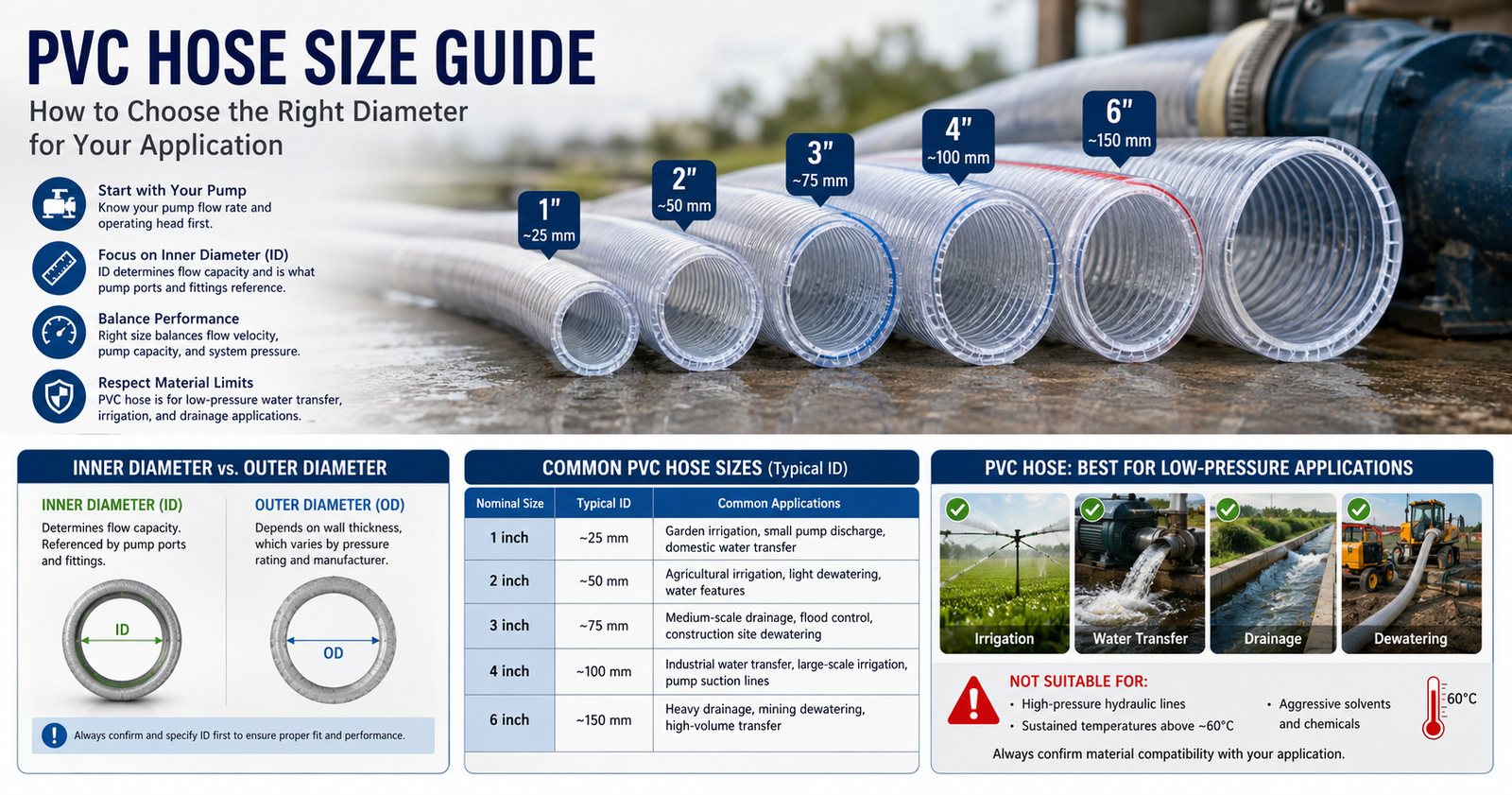
Getting PVC hose size wrong isn't just inconvenient — it means delayed projects, return freight costs, and a pump that either can't prime or burns itself out pushing against the wrong resistance. Most buyers I speak with treat sizing as a simple measurement task. It rarely is.
Choosing the correct PVC hose size starts with knowing your pump specifications and connection dimensions before you look at any size chart. Inner diameter is the primary selection dimension, not outer diameter. The right diameter balances flow velocity, pump capacity, and system pressure — and in most low-pressure pump applications, bigger is not always better.

Understanding why size matters — and what data you actually need — will save you from the most common sourcing mistakes we see from buyers every week. Let's work through this properly.
Why Does PVC Hose Size Matter More Than You Think?
Most buyers assume sizing is just about fitting the connection. The connection fit is the minimum requirement — but it's not the only thing at stake.
The real problem is that wrong hose diameter affects your entire system's performance, not just the joint. Diameter controls flow velocity, which affects pump efficiency, priming behavior, and pressure loss over the length of the run. A hose that fits the coupling but mismatches the pump will cost you more in wasted energy and downtime than the hose itself ever cost.

Here is a principle I always share with buyers before we discuss specific sizes:
Pump specifications come before hose size — not the other way around. Your pump's flow rate and head define the diameter range that will work. Hose sizing is a downstream decision.
If you don't know your pump's rated flow rate (in liters per minute or gallons per minute) and operating head, you cannot confirm a hose size with any confidence. This is not a formality — it is the foundation of the whole selection process.
Inner Diameter vs. Outer Diameter: Where Most Orders Go Wrong
We regularly receive inquiries where a buyer says "I need a 2-inch hose" without specifying whether that measurement refers to the inner diameter (ID) or the outer diameter (OD). This single ambiguity causes more fitment failures than any other factor.
Here is why it matters:
- Inner diameter (ID) determines flow capacity. It is also what most pump ports and fittings reference.
- Outer diameter (OD) depends on wall thickness, which varies by pressure rating and manufacturer. Two hoses with the same ID can have very different ODs.
Always confirm and specify ID first. When you order by ID, the connection geometry is predictable. When you order by OD without specifying ID, the actual bore you receive depends on a wall thickness assumption that may not match your pump port.
PVC Has Limits Sizing Can't Solve
Before we go further, one guardrail worth stating clearly:
PVC flexible hose is appropriate for low-pressure water transfer, irrigation, and drainage[^1]. It is not suitable for high-pressure hydraulic lines, sustained exposure to temperatures above approximately 60°C[^2], or contact with aggressive solvents and chemicals. If your application involves any of these conditions, confirm material compatibility before sizing. Choosing the right diameter on the wrong material solves nothing.
What Are the Common PVC Hose Sizes?
The industry uses a standard set of nominal diameters. Here is a practical reference based on typical applications we supply to:
| Nominal Size | Typical ID | Common Applications |
|---|---|---|
| 1 inch | ~25 mm | Garden irrigation, small pump discharge, domestic water transfer |
| 2 inch | ~50 mm | Agricultural irrigation, light dewatering, water features |
| 3 inch | ~75 mm | Medium-scale drainage, flood control, construction site dewatering |
| 4 inch | ~100 mm | Industrial water transfer, large-scale irrigation, pump suction lines |
| 6 inch | ~150 mm | Heavy drainage, mining dewatering, high-volume transfer |
A few notes on reading this table:
- "Nominal size" is a label, not always a precise measurement. Confirm actual ID with your supplier against your pump port dimension.
- Wall thickness varies. A 2-inch hose at 4 bar rated pressure will have a thicker wall — and therefore larger OD — than a 2-inch hose at 2 bar[^3]. Same ID, different OD.
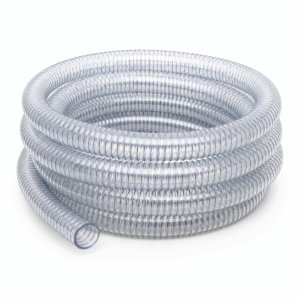
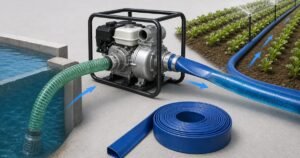
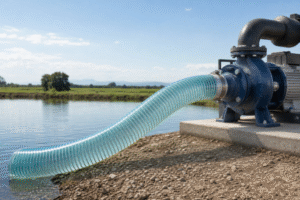
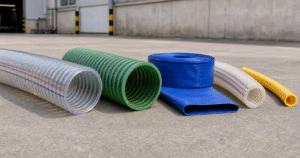
- Suction hose and discharge hose have different wall construction. Suction hose requires a spiral reinforcement to resist collapse under negative pressure. Size them separately.
1 Inch PVC Hose
Best for: Small domestic pumps, drip irrigation headers, garden water supply.
At this diameter, flow volumes are modest. The 1-inch hose suits submersible pumps in the 30–80 LPM range[^4]. If your pump exceeds this flow range, moving up to 1.5 inch or 2 inch will reduce back pressure and improve efficiency.
2 Inch PVC Hose
Best for: Agricultural irrigation, pond pumps, light construction dewatering.
This is one of the most common sizes we ship. A 2-inch PVC hose matches the discharge port on many mid-range centrifugal pumps rated at 150–400 LPM. Buyers often upgrade from 1.5-inch to 2-inch when they find their pump running hot or struggling to maintain pressure — a sign the bore is restricting flow.
3 Inch PVC Hose
Best for: Site drainage, medium-volume transfer, flood response.
At 3 inches, you are handling substantial flow. This size is common in construction site dewatering where pumps run continuously. Matching the hose ID to the pump discharge port exactly is especially important here — even a half-inch mismatch introduces turbulence that accumulates over a long run[^5].
4 Inch PVC Hose
Best for: Heavy irrigation, large-scale water transfer, industrial drainage.
Four-inch hose is where buyers often encounter the oversizing problem. A centrifugal pump sized for 3-inch discharge loses velocity efficiency when connected to 4-inch hose. I have had customers report poor priming and unstable flow after upsizing — this is a textbook case of diameter exceeding pump design capacity.
6 Inch PVC Hose
Best for: High-volume dewatering, mining, civil infrastructure drainage.
At this size, you are moving large volumes at low velocity. Pump selection becomes critical — the pump must generate sufficient head to maintain flow across the full hose length. Always confirm both pump flow rate and operating head before ordering at this diameter.
How Does Diameter Affect Performance?
This is where buyers move from measurement to decision-making. Diameter does three things that directly affect your results.
The core relationships between hose size and system behavior are not obvious from a spec sheet alone. Understanding them prevents the most expensive mistakes in PVC hose procurement.

Flow Rate
Larger inner diameter = greater cross-sectional area = higher potential flow at the same velocity. This much is straightforward. However, flow rate is set by your pump, not by your hose. The hose's job is to not restrict what the pump can deliver. If your hose ID is smaller than your pump discharge port, you are creating a bottleneck. If it matches or slightly exceeds the port, you are not restricting flow.
Key point: selecting a hose ID equal to or slightly larger than your pump's discharge port is the baseline rule. Significantly larger is where problems begin.
Pump Efficiency
This is the counterintuitive one. In low-pressure pump systems — centrifugal pumps, submersible pumps, standard dewatering equipment — oversizing the hose diameter reduces pump efficiency.
Here is the mechanism: centrifugal pumps are designed around a specific flow velocity range[^6]. When hose diameter increases significantly, velocity drops. Lower velocity means the pump works harder to maintain head, priming becomes less reliable, and in some cases the pump cannot self-prime at all. Several customers have described exactly this scenario after switching to a larger hose assuming it would improve output. The result was the opposite.
The practical rule: match your hose diameter to your pump's design parameters, not to an assumption that bigger allows more flow.
Pressure Loss
Friction loss accumulates over the length of a hose run[^7]. Larger diameters reduce friction loss per meter. This becomes material over long runs — anything above 20 meters where pressure loss starts reducing effective flow at the outlet[^8].
For long-run applications:
- Calculate expected friction loss across the total hose length
- If loss is significant, consider stepping up one size — but cross-check against pump efficiency before doing so
- Confirm your pump has sufficient head to compensate for whatever friction loss remains
How to Choose PVC Hose Size for Different Applications
Application type shapes the selection logic before you even look at a size.
Getting the right PVC hose diameter is a matching exercise between four variables: connection geometry, pump design, operating environment, and run length. Miss any one of them and the other three can't compensate.
Agricultural Irrigation
- Match hose ID to pump discharge port
- Account for total run length and elevation change (head)
- Suction hose needs spiral reinforcement — size it separately from discharge
Construction Site Dewatering
- Continuous operation demands exact ID match to pump discharge
- Account for suspended solids if pumping muddy water — check wall thickness and abrasion rating
- Run length can be long; calculate friction loss before finalizing size
Industrial Drainage
- High flow volumes favor 4-inch or 6-inch, but verify pump design capacity first
- Confirm fluid temperature and chemistry — this is where PVC limits matter most
- Specify suction vs. discharge clearly; construction differs
What Information Should Buyers Provide Before Ordering?
This is where the article becomes actionable. The four pieces of information below are what I ask every buyer before recommending a size. Providing them upfront shortens your lead time, reduces back-and-forth, and prevents the wrong product from leaving the factory.
1. Connection Size (ID or OD — Specify Which)
State the actual measured dimension of your pump discharge or suction port. Specify whether your measurement is ID or OD. If you have a coupling or fitting already, share the thread type and size. Do not just say "2-inch" — confirm which dimension that refers to.
2. Pump Information
Provide:
- Pump type (centrifugal, submersible, self-priming, diaphragm, etc.)
- Rated flow rate (LPM or GPM)
- Operating head (meters or feet)
- Discharge port size and thread type
Without this, any size recommendation is a guess.
3. Working Environment
- What fluid are you transferring? (Water, slurry, chemicals?)
- What is the fluid temperature?
- Outdoor or indoor installation?
- Is this a suction line, discharge line, or both?
These factors affect wall construction, reinforcement type, and whether PVC is the right material at all.
4. Required Length
Total hose run length affects friction loss calculations and determines whether you need to step up a size to compensate. Also confirm whether you need end fittings supplied with the hose.
Frequently Asked Questions
Is PVC hose size based on inner diameter or outer diameter?
Inner diameter is the primary specification for most applications. It determines flow capacity and how the hose connects to pump ports and fittings. Outer diameter varies with wall thickness and pressure rating. Always confirm ID first, and specify which dimension you are referencing when requesting a quote.
Can I use a larger diameter PVC hose to increase flow from my pump?
Not reliably — and sometimes the opposite happens. In centrifugal and self-priming pump systems, oversizing the hose drops flow velocity below the pump's design range, reducing efficiency and causing priming problems[^9]. Match hose diameter to your pump's discharge port specification rather than assuming larger means more flow.
What is the maximum pressure rating for PVC flexible hose?
This depends on wall thickness, reinforcement type, and nominal diameter — but PVC flexible hose is generally suited to low-pressure water transfer applications, typically under 6–10 bar[^10] depending on construction. PVC is not appropriate for high-pressure hydraulic applications. Always verify the pressure rating against your working pressure before ordering.
Do I need different hose specifications for suction and discharge lines?
Yes. Suction hose must resist collapse under negative pressure and typically includes a rigid spiral reinforcement inside the wall[^11]. Discharge hose is designed for outward pressure and has a different wall construction. Specify which role each hose serves when placing your order.
What information should I have ready before requesting a PVC hose quote?
Prepare your pump's flow rate and head, your connection port size (with ID or OD specified), the fluid type and temperature, whether you need suction or discharge construction, and the total run length. This information allows a supplier to give you an accurate size recommendation rather than a generic one.
Conclusion
Choosing the right PVC hose size comes down to one principle: get the information right before you select the product. Inner diameter, not outer diameter, is where you start. Pump specifications define the sizing boundaries — hose selection follows pump parameters, not the other way around. And in pump-driven systems, bigger diameter is not always better. Oversizing is a real cause of poor pump performance and failed priming that we see in buyer inquiries regularly.
If you are preparing to source PVC hose for irrigation, drainage, or industrial water transfer, gather your pump specs, confirm your connection dimensions (ID or OD), know your fluid and environment, and calculate your run length. Then reach out.
Ready to specify your PVC hose? Contact us with your pump flow rate, connection size, fluid type, and required length — and we will confirm the right diameter and construction for your application.
[^1]: "Flexible PVC Pipe | Durable Flex Tubing for Plumbing", https://www.pvcfittingsonline.com/collections/flexible-pvc-pipe?srsltid=AfmBOopvgzZGdxLMVHaGw5t_4eBXwaproEGIPL1BU0OPV17lhaldfeod. Industry standards confirm PVC flexible hose is commonly specified for low-pressure fluid transfer applications including irrigation and drainage systems, where operating pressures typically remain below 10 bar. Evidence role: general_support; source type: institution. Supports: the classification of PVC flexible hose as suitable for low-pressure water applications. Scope note: Standards describe typical applications but may not exhaustively list all appropriate or inappropriate uses [^2]: "Heat Capacity and Thermodynamic Properties of Poly(Vinyl Chloride)", https://pmc.ncbi.nlm.nih.gov/articles/PMC6751956/. PVC compounds used in flexible hose applications typically exhibit reduced mechanical properties and accelerated degradation at sustained temperatures exceeding 60°C, with exact limits varying by formulation and plasticizer content. Evidence role: statistic; source type: research. Supports: the temperature limitation of PVC flexible hose materials. Scope note: Temperature ratings vary by specific PVC formulation and may differ from generic thresholds [^3]: "Axial and hoop stresses in thin-walled pressure vessels", https://www.purdue.edu/freeform/me323/wp-content/uploads/sites/2/2023/07/pressure_vessels-1.pdf. Hose wall thickness is determined by hoop stress calculations based on working pressure, material strength, and safety factors; higher rated pressures require proportionally thicker walls or stronger reinforcement to contain internal forces, increasing overall outer diameter when inner diameter remains constant. Evidence role: mechanism; source type: education. Supports: the relationship between pressure rating and required wall thickness in hose design. [^4]: "Pipe Water Velocity and Minimum Pipe Diameter Calculator", https://irrigation.wsu.edu/Content/Calculators/General/Pipe-Velocity.php. Hydraulic design guidelines typically recommend maintaining flow velocities between 0.9 and 2.4 meters per second in water distribution systems to balance friction losses with erosion prevention; for 25mm (1-inch) ID conduits, this velocity range corresponds approximately to flow rates of 30-110 liters per minute. Evidence role: general_support; source type: education. Supports: recommended flow rate ranges for given pipe or hose diameters. Scope note: Optimal flow rates depend on application-specific factors including acceptable pressure loss, fluid properties, and system economics [^5]: "Borda–Carnot equation", https://en.wikipedia.org/wiki/Borda%E2%80%93Carnot_equation. Abrupt changes in conduit diameter create flow separation, recirculation zones, and turbulence, resulting in minor head losses at the transition and potentially affecting flow characteristics downstream; these losses are quantified in hydraulic engineering as expansion or contraction loss coefficients. Evidence role: mechanism; source type: education. Supports: the generation of turbulence and energy loss from dimensional transitions in flow paths. Scope note: The practical significance of minor losses depends on total system head and may be negligible in short, low-velocity applications [^6]: "flow rate [m /s] efficien cy", https://engineering.purdue.edu/~wassgren/teaching/ME30900/Examples/pump_13.pdf. Centrifugal pump performance is characterized by design curves that define optimal efficiency within specific flow velocity and head ranges; operation outside these parameters typically results in reduced efficiency and potential cavitation or priming issues. Evidence role: mechanism; source type: education. Supports: the relationship between centrifugal pump design and optimal flow velocity ranges. Scope note: Specific velocity ranges vary significantly by pump design, impeller geometry, and intended application [^7]: "Darcy–Weisbach equation", https://en.wikipedia.org/wiki/Darcy%E2%80%93Weisbach_equation. Friction loss in fluid-carrying conduits is proportional to length, as described by the Darcy-Weisbach equation and similar hydraulic formulas, where pressure drop increases linearly with distance traveled at constant flow conditions. Evidence role: mechanism; source type: encyclopedia. Supports: the relationship between conduit length and cumulative friction loss. [^8]: "Pipeline Pressure Loss Calculators - Irrigation in the Pacific Northwest", https://irrigation.wsu.edu/Content/Calculators/General/Pipeline-Pressure-Loss.php. In flexible hose systems, friction loss magnitude depends on diameter, flow rate, and surface roughness, with longer runs accumulating proportionally greater losses; the point at which losses materially affect system performance varies but typically becomes relevant in residential and light commercial applications at distances exceeding 15-25 meters. Evidence role: general_support; source type: education. Supports: the distance at which friction losses become operationally significant. Scope note: The specific distance threshold varies significantly with hose diameter, flow rate, and acceptable pressure drop tolerances [^9]: "How Pipe Diameter Affects Flow Rate: The Complete Engineering Guide", https://iwakiamerica.com/blog/how-pipe-diameter-and-length-influence-pump-requirements/. When discharge piping significantly exceeds pump outlet dimensions, reduced fluid velocity can decrease velocity head contribution and affect self-priming capability in centrifugal pumps, particularly those relying on minimum velocity for proper operation. Evidence role: mechanism; source type: education. Supports: the negative effects of reduced flow velocity on pump performance. Scope note: Effect magnitude varies by pump type; some pump designs are less sensitive to discharge line oversizing than others [^10]: "Besides PVC, PEX, drip, etc. what flexible pipe can ...", https://www.facebook.com/groups/1594952854094348/posts/3965544147035195/. Standard PVC flexible hoses for agricultural and light industrial applications are commonly rated for working pressures between 2 and 10 bar, depending on wall thickness and reinforcement construction, with higher-rated products requiring additional layers or different reinforcement materials. Evidence role: statistic; source type: institution. Supports: typical pressure ratings for PVC flexible hose products. Scope note: Pressure ratings vary widely by construction method, wall thickness, and manufacturer specifications [^11]: "Suction hose", https://en.wikipedia.org/wiki/Suction_hose. Hoses used in suction applications experience external atmospheric pressure exceeding internal pressure, creating collapse risk; spiral wire or rigid helix reinforcement embedded in or beneath the hose wall provides structural support to maintain bore integrity under vacuum conditions. Evidence role: mechanism; source type: education. Supports: the necessity of reinforcement in suction hose construction.