Distributors building a PVC hose product range often face the same frustrating problem: customers describe a job, not a specification. If you can't quickly map their application to the right hose construction, you either lose the sale or ship the wrong product. PVC hose applications span agriculture, construction, and industry — and each scenario demands a different answer.
PVC hose applications cover four primary use environments: agricultural irrigation, construction dewatering, industrial water transfer, and mining or heavy-duty fluid handling. Each environment places different demands on pressure rating, wall construction, and material grade. Matching the right hose type to the right application is the foundation of a profitable, low-return product range.

Understanding the application logic behind each category helps you stock smarter, explain products more confidently to downstream buyers, and avoid the costly returns that come from selling on price alone. Let's walk through each segment.
Agricultural Irrigation Applications: What Do Farmers Actually Need?
Most distributors entering the PVC hose market start with agriculture. It's the highest-volume segment, and the inquiry language is familiar: water transfer, pump hookup, field irrigation. But "irrigation hose" is not one product — it's a category that collapses into very different specifications depending on how the water moves.
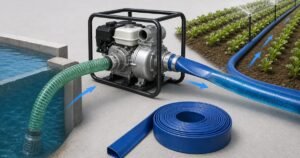
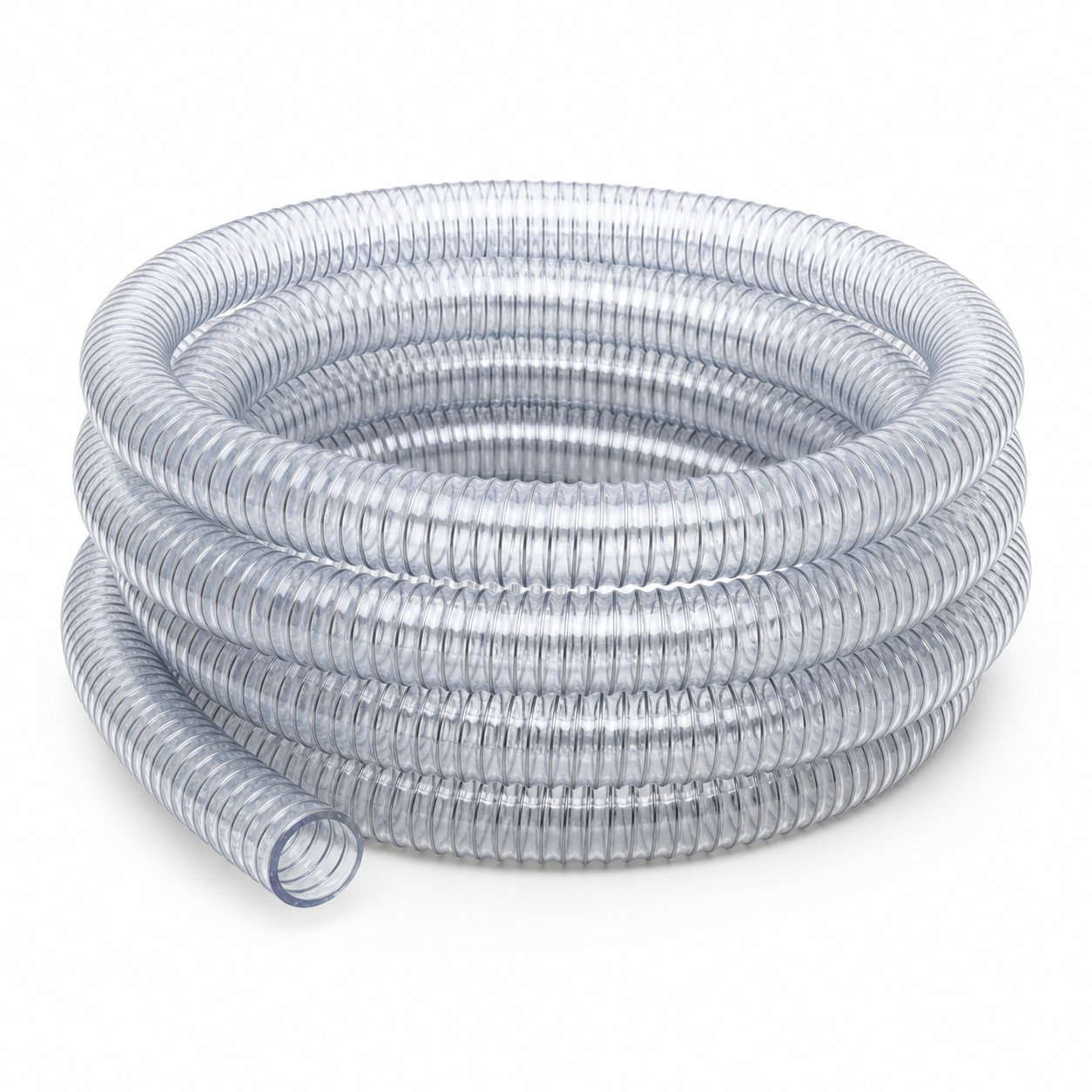
In agricultural irrigation, PVC hose is used for three core tasks: transferring water from a source to a distribution point, connecting pumps to intake or discharge lines, and running water through field irrigation layouts. Transparent PVC hose handles most gravity-fed and low-pressure tasks. Steel-wire reinforced PVC hose is required wherever pump pressure is involved.

The distinction between transparent and reinforced hose is the most important call a distributor makes in this segment. Getting it wrong is expensive — not for the factory, but for your customer's reputation on-site and for your own returns rate.
Water Transfer in Agricultural Settings
Water transfer in agriculture usually means moving water between a pond, tank, or canal and a storage or distribution point. This is often gravity-fed or assisted by a low-head pump. Here, clear PVC hose is the practical choice:
- Operators can visually confirm flow without cutting into the line
- The flexibility of clear PVC makes it easy to lay and reposition across uneven terrain
- Cost per meter is competitive, which matters at scale in large farm operations
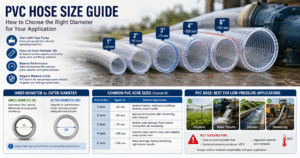
In orders we handle, agricultural water transfer is the application that generates the most requests for clear hose in larger diameters — 2 inch to 4 inch inner diameter is typical. Wall thickness still matters here. A distributor who sources thin-wall clear hose to hit a low price point will get hose that kinks under its own weight in warm weather.
Pump Connection in Agriculture
Pump connections are where many distributors make their first specification mistake. A pump generates real pressure — even a small centrifugal pump used for field irrigation can push 3–6 bar on the discharge side[^1]. Transparent PVC without reinforcement is not rated for sustained pump discharge pressure. It will balloon, split at fittings, or collapse on the suction side.
For pump connection applications, steel-wire reinforced PVC hose is the reliable default:
- The embedded spiral steel wire prevents collapse under suction and burst under discharge pressure
- Working pressure ratings for standard reinforced PVC hose typically range from 8 to 16 bar depending on wall thickness and diameter[^2]
- The transparent or semi-transparent body still allows flow monitoring, which agricultural users prefer
Distributors who stock only clear hose will lose pump-related orders or, worse, ship the wrong product and handle returns.
Farm Irrigation Layout
For field irrigation runs — the lateral lines and risers connecting to drip or sprinkler heads — the pressure is lower and the hose is often semi-permanent for a season. Here, flexibility and UV resistance become selection factors alongside pressure rating[^3]. Not all PVC compounds perform equally under sustained UV exposure[^4]. If your supply chain does not confirm UV stabilizer content in the formulation, assume standard grades need protective covering or burial for long field deployments.
Construction Dewatering Applications: Where Hose Failures Are Most Visible
Construction dewatering is the segment where I see the most direct, urgent buying behavior from distributors. A construction site that can't drain is a stopped site. Buyers are less price-sensitive and more concerned with whether the hose will hold up during a pump-intensive drainage push.
In construction dewatering, PVC hose is used for site drainage, active water removal from excavations, and pump discharge routing across the work site. These applications require steel-wire reinforced PVC hose rated for continuous pump pressure. Failure under load on a construction site damages the end-user's schedule and the distributor's supplier credibility.

Site Drainage and Water Removal
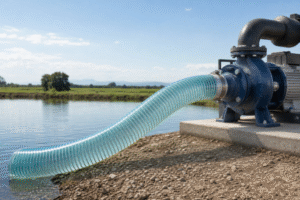
Construction sites collect groundwater, rainwater, and runoff[^5]. Moving that water off-site requires pumps — submersible drainage pumps, centrifugal pumps, or diesel-driven trash pumps. The discharge hose runs from the pump outlet to a disposal point, often over rough ground, through constrained access, and under physical abuse from site traffic and equipment.
Key selection criteria for construction dewatering hose:
| Requirement | Why It Matters | Safe Default |
|---|---|---|
| High working pressure | Pump discharge pressure can exceed 10 bar | Reinf. PVC, rated ≥10 bar |
| Abrasion-resistant outer wall | Ground contact and dragging degrade cheaper formulations | Confirm wall thickness ≥ 5mm on larger diameters |
| Flexibility at low temperatures | Early morning construction starts in cold climates | Check low-temp flexibility spec if selling to northern markets |
| Fitting retention | Fittings pulled loose under pressure create site hazards | Specify hose OD tolerance to match fitting crimp range |
Pump Discharge Routing
Pump discharge is the highest-stress application in the construction segment. The hose must handle continuous flow, pressure surges when the pump starts and stops, and physical handling by site workers who are not treating it gently.
A distributor supplying construction rental companies or equipment dealers would typically stock reinforced PVC discharge hose in 2 inch, 3 inch, and 4 inch diameters as a core range. Beyond 4 inch, the market shifts toward layflat hose in many regions[^6] — worth knowing so you set the right product boundary with customers.
Industrial Water Transfer Applications: Broader Scope, Tighter Specs
Industrial water transfer applications use PVC hose for equipment connection and general fluid handling in manufacturing, processing, and utility environments. This segment is broader than agriculture or construction, and the specification requirements vary significantly by industry.
Industrial PVC hose applications typically include connecting water supply lines to equipment, handling cooling water circuits, and general plant water transfer. Working pressure, temperature range, and chemical compatibility are the three specification axes that matter most. PVC performs well within its limits — typically up to 60°C and moderate pressure[^7] — but has clear boundaries that buyers should verify against their specific application.

Equipment Connection and General Water Handling
In industrial settings, hose connects equipment to plant water supply, acts as flexible links between rigid pipe sections, and handles wash-down or cooling duties. Here is where PVC competes directly with rubber hose:
- Where PVC wins: Lower cost, lighter weight, visual flow monitoring with clear grades, adequate flexibility for most ambient-temperature water duties
- Where PVC reaches its limits: Applications above 60°C, contact with aggressive solvents or concentrated acids, and environments requiring food-grade or pharmaceutical certification
For distributors selling into light manufacturing, food processing peripherals, or general plant maintenance, a clear or reinforced PVC hose range covers most common needs. For heavy chemical processing or high-temperature duties, PVC is not the right recommendation — and saying so builds more trust than overpromising.
Mining and Heavy-Duty Applications: What to Know Before You Sell Into This Segment
Mining is a legitimate end-market for steel-wire reinforced PVC hose, particularly for dewatering in underground or open-pit operations and for water supply to dust suppression systems. I'll be direct here: our primary experience is in agricultural and construction supply channels. What follows reflects what distributors and manufacturers in the mining supply chain commonly specify — not first-hand project knowledge.
In mining and heavy-duty applications, PVC hose is typically used for mine dewatering, dust suppression water supply, and light equipment connections where flexibility is required. These applications generally demand higher working pressure ratings, enhanced abrasion resistance, and longer continuous lengths than standard construction grades.
Typical requirements in mining hose procurement include:
- Working pressure: Often specified at 16 bar and above for dewatering discharge lines
- Length: Mining operations frequently require continuous coil lengths of 50m or 100m to minimize connections underground
- Marking and traceability: Some mine procurement processes require batch marking on the hose for quality control documentation
- UV and ozone stability: Surface operations expose hose to extended outdoor conditions
If you are building a product range for mining distributors, confirm these specifications directly with your end-user contacts. Do not assume construction-grade reinforced hose meets mining procurement standards without verification.
Equipment Manufacturers Using PVC Hose: A Secondary Buyer Worth Understanding
OEM equipment manufacturers — particularly those producing irrigation machinery, portable pumps, or construction dewatering equipment — are another buyer segment worth knowing. They source hose in volume against fixed specifications, and they need consistent dimensional tolerances for assembly line fit.
Distributors who supply OEM accounts should expect:
- Written specifications with inner diameter, outer diameter, and wall thickness tolerances
- Working pressure test requirements, sometimes with batch test certification
- Consistent color matching if hose is branded or visible on the finished equipment
- Delivery scheduling tied to production runs rather than spot orders
OEM business is sticky if you get it right, and specification compliance is what earns the relationship. Price matters, but dimensional consistency and on-time delivery matter more.
How Distributors Select PVC Hose Product Range: The Decision Logic
This is the section most online guides skip. Knowing the applications is useful — but deciding what to actually stock is the real question for a distributor.
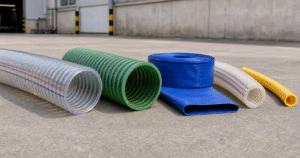
Distributors building a PVC hose range should start with two core product types: clear PVC hose for low-pressure and gravity-fed agricultural applications, and steel-wire reinforced PVC hose for pump-connected and construction dewatering applications. These two types, stocked in the diameter range most common in your target market, cover the majority of volume inquiries.
Here is a practical framework for building a starter range:
Step 1: Identify Your Primary Application Market
Ask yourself: are most of your downstream customers in agriculture, construction, or general industrial? Your answer determines which hose type becomes your anchor SKU.
[^1]: "Irrigation Water Pumps", https://www.ndsu.edu/agriculture/extension/publications/irrigation-water-pumps. Engineering references for centrifugal pump performance in agricultural irrigation contexts indicate discharge pressures commonly in the range of 2–8 bar depending on pump head rating, impeller diameter, and flow rate; the 3–6 bar figure cited here falls within this range for mid-sized field units. Evidence role: statistic; source type: research. Supports: Typical discharge pressure range of small centrifugal pumps used in agricultural irrigation. Scope note: Exact pressure varies significantly with pump model, pipeline resistance, and elevation change; a single cited range may not reflect all configurations. [^2]: "PVC Steel Wire Reinforced Hose Specs | PDF", https://www.scribd.com/document/519247958/CCW-PVC-Steel-Wire-Hose-Catalogue. Standards bodies such as ISO and EN publish hose pressure rating methodologies (e.g., ISO 1402 for hydrostatic testing of hoses) under which reinforced PVC hose is typically rated; published product data conforming to these standards commonly shows working pressures of 8–16 bar for wire-reinforced constructions across standard diameter ranges. Evidence role: general_support; source type: institution. Supports: Working pressure ratings for steel-wire reinforced PVC hose across diameter and wall thickness variants. Scope note: Actual rated pressure depends on the specific construction and diameter tested; the range cited is a general industry figure and should be verified against the specific product's conformity documentation. [^3]: "Irrigation pipe recommendations for UV resistance", https://www.facebook.com/groups/1156935537680311/posts/9334687416571708/. Studies on polymer weathering in agricultural environments document that continuous solar UV exposure causes embrittlement and loss of tensile strength in unstabilized flexible PVC, shortening service life in above-ground field deployments; UV-stabilized formulations or burial practices are recommended to mitigate this effect. Evidence role: mechanism; source type: research. Supports: UV exposure as a degradation driver for PVC hose deployed in open agricultural field conditions. Scope note: Quantitative degradation rates depend on geographic UV index, hose wall thickness, and specific PVC formulation; generalized findings from weathering studies may not directly predict performance for a given product. [^4]: "Photodegradation and photostabilization of polymers ...", https://pmc.ncbi.nlm.nih.gov/articles/PMC4320144/. Polymer degradation research demonstrates that PVC undergoes photo-oxidative degradation upon UV exposure, manifesting as discoloration, embrittlement, and loss of tensile strength; the inclusion of UV stabilizers such as hindered amine light stabilizers (HALS) or UV absorbers is documented to significantly retard this degradation process. Evidence role: mechanism; source type: research. Supports: The role of UV stabilizer additives in determining the outdoor weathering performance of PVC compounds. Scope note: Published research typically addresses rigid or semi-rigid PVC formulations; performance data specific to flexible plasticized PVC hose under field UV conditions is less systematically documented. [^5]: "Field Guide to Construction Site Dewatering - Caltrans", https://dot.ca.gov/-/media/dot-media/programs/construction/documents/environmental-compliance/field-guide-to-construction-site-dewatering-a11y.pdf. Civil engineering and construction management references define construction dewatering as the removal of groundwater seepage, surface water infiltration, and precipitation runoff from excavations and work areas to maintain safe and workable site conditions. Evidence role: definition; source type: education. Supports: Categories of water accumulation addressed by construction site dewatering operations. Scope note: The relative significance of each water source varies with site geology, season, and excavation depth; the article's list is consistent with standard dewatering definitions but does not reflect site-specific hydrology. [^6]: "PVC Layflat Hose Manufacturer & Supplier – Factory Price", https://www.sunhose.com/layflat-hose/?srsltid=AfmBOoqiFSdsctS10S7psUnEiMVzYXJXQDIuS_jPYx-Q2LW-5_bcFi5J. Industry procurement guides for construction dewatering commonly specify layflat discharge hose for diameters of 4 inches and above, citing handling weight, coil storage efficiency, and cost per meter as practical drivers of the substitution relative to rigid-wall reinforced PVC hose. Evidence role: general_support; source type: other. Supports: The transition from reinforced PVC hose to layflat hose at larger diameters in construction dewatering contexts. Scope note: The diameter threshold at which layflat becomes preferred varies by region, application pressure, and supplier range; this is a market convention rather than a codified standard. [^7]: "Thermomechanical Properties of Nontoxic Plasticizers for Polyvinyl ...", https://pmc.ncbi.nlm.nih.gov/articles/PMC10214373/. Plasticized PVC (flexible PVC) is generally reported in polymer science literature to have a continuous service temperature ceiling of approximately 60°C, above which plasticizer migration and mechanical degradation accelerate, reducing pressure retention and flexibility. Evidence role: definition; source type: encyclopedia. Supports: Upper continuous service temperature for plasticized PVC used in hose applications. Scope note: The precise threshold varies with plasticizer type and concentration, wall thickness, and whether the application involves static or dynamic pressure; 60°C should be treated as a conservative guideline rather than an absolute limit.