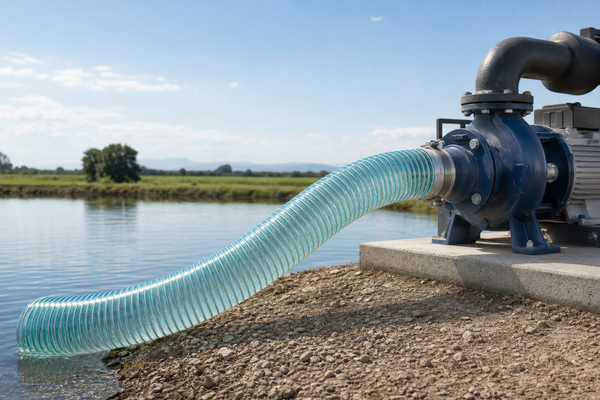
Choosing the wrong PVC suction hose doesn't just mean a bad product — it means a pump that won't draw, a collapsed hose wall, and a return shipment nobody wanted. Yet this happens more often than it should, usually because buyers treat hose selection as a size decision when it's actually a structure and application decision.
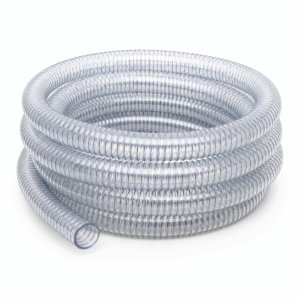
A PVC suction hose is a reinforced flexible hose designed to maintain its inner diameter under negative pressure. It uses a rigid spiral — typically PVC or steel wire — embedded in the wall to resist collapse when a pump creates vacuum on the suction side. Without this reinforcement, the hose wall folds inward, blocks flow, and the pump runs dry. The right hose matches pump inlet size, handles the medium being transferred, and carries enough vacuum rating for the application.

Understanding why suction hoses are built differently from discharge hoses is the first step. Once that distinction is clear, selecting the right size and specifications becomes much more straightforward — and the quotation process goes a lot smoother too.
What Is a PVC Suction Hose?
Most buyers already know what a suction hose is supposed to do. But when a hose fails in the field, it's usually because someone skipped the part about how it does it.
A PVC suction hose is a flexible hose built specifically to work under negative pressure (vacuum) on the inlet side of a pump. Its defining feature is spiral reinforcement that prevents the hose wall from collapsing inward when suction is applied.

This is different from a standard PVC hose, which is designed to handle pressure pushing outward. The construction logic is reversed — and that reversal matters enormously in how the hose performs.
What Makes It a "Suction" Hose?
The term "suction hose" is not marketing language. It describes a specific structural requirement:
- The pump creates negative pressure on its inlet side to draw fluid in.
- That negative pressure acts on the inside wall of the hose, trying to pull it inward.
- Without reinforcement, even a thick PVC wall will deform under sustained vacuum.
- The rigid spiral holds the inner diameter open so fluid can flow continuously.
Where Is It Used?
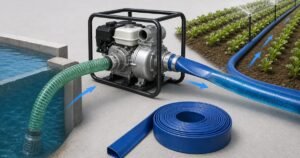
PVC suction hoses appear in a wide range of pump applications:
| Application | Typical Medium | Notes |
|---|---|---|
| Agricultural irrigation | Clean water | Standard suction setup |
| Construction dewatering | Water with sediment | May need abrasion-resistant liner |
| Swimming pool systems | Treated water | Chemical compatibility matters |
| Industrial fluid transfer | Varies | Confirm medium before specifying |
| Water supply trucks | Clean water | Large diameter common |
The hose type is defined by the direction of pressure, not by the fluid. Whether it's water, slurry, or a light industrial liquid — if the hose sits on the suction side of a pump, it needs spiral reinforcement.
PVC Suction Hose vs Discharge Hose — What's the Real Difference?
Here's the failure case I see most often. A buyer places an order for "pump hose," receives standard PVC discharge hose, connects it to the suction inlet, and calls back two weeks later because the pump won't pull water. When we investigate, the hose wall has partially collapsed. The pump is fine. The hose is the wrong type.
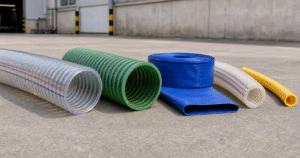
The fundamental difference is this: a discharge hose is built to resist outward pressure; a suction hose is built to resist inward collapse. They are not interchangeable. Using a discharge hose on the suction side will result in wall collapse and total pump failure under vacuum.

This is not a quality issue. It's a structure issue. Even a high-grade discharge hose will collapse on the suction side because it was never designed to handle negative pressure.
Suction Application
On the suction side, the pump creates a partial vacuum inside the hose. The external atmospheric pressure is higher than the internal pressure. This pressure differential tries to crush the hose from the outside in.
- Hose must maintain its shape under this load
- Any deformation reduces flow cross-section and chokes the pump
- Sustained collapse can damage pump internals by running dry
Discharge Application
On the discharge side, the pump pushes fluid out. Internal pressure is higher than external pressure.
- The hose wall is pushed outward, not inward
- Burst pressure rating matters here
- Wall flexibility is acceptable — collapse is not a risk
- No spiral reinforcement required
Structure Difference
| Feature | PVC Suction Hose | PVC Discharge Hose |
|---|---|---|
| Spiral reinforcement | Yes — required | No — not present |
| Wall function | Containment + collapse resistance | Containment + burst resistance |
| Flexibility | Moderate (limited by spiral pitch) | High |
| Vacuum rating | Rated for negative pressure | Not rated for vacuum |
| Typical wall thickness | Heavier | Lighter |
| Weight per meter | Higher | Lower |
The price difference between the two types reflects real material and manufacturing differences — not a premium for branding. When a buyer asks why the suction hose costs more, this table is the answer.
How Does Spiral Reinforcement Work?
The spiral is the defining feature of any PVC spiral suction hose. But buyers often misunderstand what it actually does — and that misunderstanding leads to wrong specs.
Spiral reinforcement in a PVC suction hose is a rigid helical structure embedded in or bonded to the hose wall. Its sole functional purpose is to maintain the inner diameter under vacuum. It does not increase burst pressure. It prevents inward wall collapse so the pump can sustain suction without flow restriction.

Think of it this way: the PVC wall keeps the fluid in; the spiral keeps the wall from caving in.
PVC Wall Structure
The wall itself is usually a flexible PVC compound. It provides:
- Fluid containment — keeps the medium inside
- Flexibility — allows the hose to bend and route around obstacles
- Weather resistance — standard PVC handles outdoor exposure reasonably well
But flexible PVC has low resistance to inward deformation under vacuum. Under sustained negative pressure, it will yield.
Spiral Support
The spiral — usually rigid PVC or steel wire, depending on the hose series — is bonded to the outer surface or embedded between wall layers at a fixed pitch. It works like a structural cage:
- Each coil acts as an independent compression ring
- The pitch (spacing between coils) determines flexibility vs. rigidity trade-off
- Closer pitch = stiffer hose, better vacuum resistance
- Wider pitch = more flexible, but slightly more susceptible to local deformation
When a buyer needs a hose that routes through tight spaces and handles high vacuum, the spiral pitch selection matters. This is worth discussing with your supplier before finalizing specs.
Vacuum Resistance
Vacuum resistance — sometimes called vacuum rating — tells you how much negative pressure the hose can sustain without collapsing. It is not the same as burst pressure.
- Burst pressure = maximum internal positive pressure before failure
- Vacuum rating = maximum negative pressure before wall collapse
A hose with a high burst pressure but no spiral reinforcement has zero useful vacuum rating. This is exactly why discharge hoses fail on suction applications. Buyers evaluating hose specs should always look for the vacuum rating separately from burst pressure — they measure completely different failure modes.
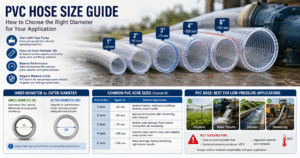
How to Select the Correct Hose Size?
Inner diameter is the first number most buyers ask about. It matters — but it's not enough on its own. I get inquiries every week from buyers who send "25mm ID, 5 meters" and expect a complete recommendation. That's only half the information needed.
Correct hose size selection requires matching the pump inlet connection size, confirming the flow volume the application demands, and understanding the operating conditions — including vacuum level, medium type, and temperature range. ID alone is not a valid specification.

Pump Connection
This is the most common source of sizing errors:
- Pump inlet size is the starting point — not what looks approximately right
- Pump manufacturers specify inlet size in inches or mm — confirm which standard your pump uses
- A 1-inch fitting is approximately 25mm but not exactly — fitting tolerance matters at connection points
- Mismatched connections cause leaks at the inlet joint, which breaks the vacuum seal and kills pump performance immediately
Always get the pump inlet diameter and connection type (threaded, flanged, or clamp) before recommending a hose.
Flow Requirement
Flow volume — measured in liters per minute or cubic meters per hour — determines the minimum acceptable inner diameter.
- Undersized ID creates excessive velocity → higher friction loss → reduced pump output
- Oversized ID is usually acceptable but increases cost and weight
- For standard pump applications, the pump manufacturer often specifies recommended hose ID in the installation manual — use that first
Working Condition
Beyond size, buyers need to confirm:
| Parameter | Why It Matters |
|---|---|
| Medium type | Clean water vs. slurry vs. chemical affects liner and spiral material |
| Operating temperature | Standard PVC has limits — confirm with supplier for high-temp applications |
| Vacuum level | Higher vacuum requires tighter spiral pitch and thicker wall |
| Hose length | Longer runs increase friction loss — may require larger ID to compensate |
| Bend radius | Tight routing may limit spiral pitch options |
Skipping any of these leads to a hose that technically fits but fails under real operating conditions.
Common Mistakes When Choosing a Suction Hose
After handling returns and technical complaints for years, the same mistakes appear over and over. None of them are complicated — they're just easy to skip when buyers are moving fast.
The three most common mistakes are: using the wrong hose type (discharge instead of suction), selecting diameter based on ID alone without matching the pump connection, and ignoring the vacuum rating requirement. Each of these leads to predictable field failures.
Wrong Diameter
- Buyers measure "something similar" in their warehouse and order to match
- Nominal ID ≠ actual measured ID across all hose series and manufacturers
- Fitting compatibility is a separate check from ID — confirm both
- Always specify ID, OD, and fitting connection type together
Wrong Hose Type
- The collapsed-wall failure case described earlier
- Discharge hose is cheaper — some buyers substitute it knowingly to save cost, then face returns
- Some suppliers don't clearly distinguish suction from discharge in product listings — ask explicitly
- If a listing doesn't mention spiral reinforcement or vacuum rating, it is almost certainly a discharge hose
Ignoring Vacuum Requirements
- Buyers assume any suction hose handles any vacuum level
- Light-duty suction hoses are rated for low-vacuum shallow-lift applications
- Deep-well pumps, high-suction-lift setups, or self-priming pumps create significantly higher vacuum
- Under-rated hoses collapse at peak vacuum — usually when the pump is priming, which is the worst time
Information Buyers Should Provide for Quotation
When I receive an inquiry for PVC suction hose, there are six things I always ask before I can make a reliable recommendation. Buyers who provide all six get a quote the same day. Buyers who skip them get follow-up questions — and delays.
To get an accurate and reliable PVC suction hose recommendation, buyers should provide: hose inner diameter and pump inlet connection size, the medium being transferred, the vacuum level or pump type, operating temperature, required quantity, and target market or end-use application.
Here's what each piece of information actually tells me:
1. Size and Connection
"What is the pump inlet size — in inches or mm? What is the connection type?"
This eliminates the most common mismatch. Nominal sizing varies by standard. A declared "1-inch hose" from different manufacturers can differ in actual OD and fitting compatibility.
2. Application and Use Case
"Is this for irrigation, dewatering, pool systems, or industrial transfer?"
Application tells me the medium, the duty cycle, and the likely vacuum level. An irrigation hose and a construction dewatering hose have very different requirements even at the same diameter.
3. Medium Type
"What fluid is being transferred — clean water, water with solids, or a chemical?"
Standard PVC handles clean water well. Abrasive media require a reinforced or thicker inner liner. Chemical media may require a different compound altogether — I will confirm this with our product documentation before recommending.
4. Quantity
"What is the order quantity — in meters, coils, or pieces?"
Quantity affects pricing, production scheduling, and whether customization (color, length, end fittings) is feasible within the buyer's timeline.
5. Required Specifications
"Do you need a specific vacuum rating, wall thickness, spiral material, or certification?"
Some markets require specific standards. Some applications have minimum wall thickness requirements. Some buyers need steel wire spiral for higher vacuum; others use PVC spiral for standard applications. Knowing this upfront avoids back-and-forth after sampling.
6. Target Market
"Where are these hoses being sold or installed?"
Different regions have different standards, color preferences, and labeling requirements. This also helps us recommend the most suitable hose series from our range.
Frequently Asked Questions
Can I use a regular PVC hose as a suction hose?
No. A standard PVC hose without spiral reinforcement will collapse under the negative pressure created by a pump on the suction side. The inner wall folds inward, blocks flow, and the pump runs dry. Always use a purpose-built PVC suction hose with a rated vacuum resistance for suction applications.
What is the difference between PVC spiral suction hose and steel wire suction hose?
Both use helical reinforcement to resist collapse. PVC spiral hoses use a rigid PVC helix — lighter, lower cost, suitable for standard vacuum levels. Steel wire hoses use an embedded metal spiral — heavier, higher cost, better suited for high-vacuum or heavy-duty applications. The right choice depends on your pump's vacuum rating and duty cycle.
How do I know what inner diameter my pump needs?
Check the pump manufacturer's specification sheet or installation manual. It will list the recommended suction hose inner diameter and inlet connection size. Do not estimate by eye or match to an existing hose without confirming the pump's rated inlet size.
Why does hose length affect suction performance?
Longer hose runs increase friction loss, which reduces the effective suction lift of the pump. For long suction runs, you may need to increase the hose inner diameter to keep velocity and friction loss within the pump's design limits. Your pump supplier or our technical team can help calculate this.
What information do I need before requesting a quote?
At minimum: pump inlet size, medium type, required hose length and inner diameter, expected vacuum level or pump type, and order quantity. The more complete your inquiry, the faster and more accurate the recommendation will be.
Conclusion
Choosing the right PVC suction hose comes down to three decisions: hose type, hose size, and operating conditions. Discharge hose on a suction application will collapse — that failure is entirely avoidable with the right specification upfront. Spiral reinforcement is not a feature upgrade; it is a functional requirement for any pump suction application. And inner diameter alone is never enough to specify a hose correctly.
If you are sourcing PVC suction hose for distribution or wholesale, the fastest path to a reliable recommendation is a complete inquiry. Send us your pump inlet size, medium type, vacuum requirement, quantity, and target market — and we will respond with the right product, not a generic quote.